.38 Special
Taxi DriverThe .38 Special is a handgun Travis Bickle carries while driving his taxi and later uses in an armed confrontation. Its compactness and practical appeal distinguish it from the larger .44 Magnum, but the weapon’s recurring presence also gives material form to Travis’s growing preoccupation with force: first a reassuring weight in his pocket, then an instrument used in violence.
Design and Acquisition
Andy presents the .38 Special as the more suitable choice if the .44 Magnum is too large for everyday use. He describes it as a solid weapon with a very short barrel, comparable in other respects to a service pistol, and practical and flexible in use. The recommendation frames the gun as a manageable alternative to the more spectacular Magnum, which Andy associates with shooting powerfully enough to splatter a target across a wall. The .38 costs $250; its holster is offered separately for $30.
Carrying and Escalation
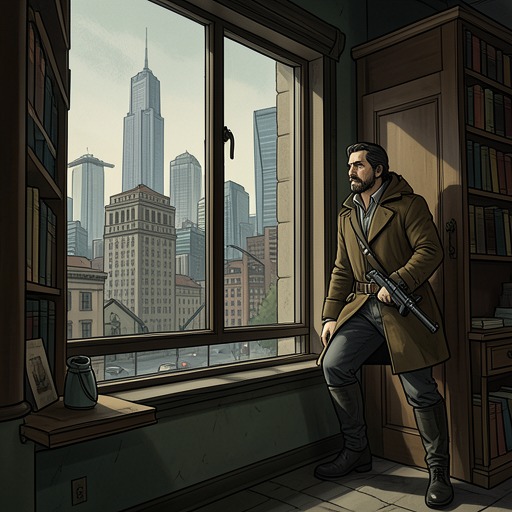
The .38 Special soon moved from purchase to constant companion: Travis began taking it to work, where its bulge in the left pocket of his jacket felt to him like insurance. While driving with the taxi’s occupied light on, he would sometimes reach over and touch the gun, an action that blurred the boundary between the routine of a night shift and the imagined violence he carried into it. He likened the weapon to an accessory from his dreams, making the gun both a tangible safeguard and part of a private fantasy.
That fantasy increasingly shaped where Travis drove and what he hoped might happen. He parked near Charles Palantine’s campaign headquarters, watching for Betsy, and deliberately began working in dangerous neighborhoods because he thought exposure to danger would keep him alert and reveal what he might do with his weapons. Yet the people he encountered were polite, tipped him, and caused no trouble. The .38 thus accompanied a search for confrontation that the streets did not fulfill; its presence intensified his expectation of violence without supplying the test he sought.
Use in Violence and Armed Confrontation
The .38 Special became an instrument of actual violence at a grocery store. When the robber turned toward Travis, Travis fired; the shot struck the man in the lower jaw and knocked Travis back against a stack of cornmeal, sending packets tumbling. The robber writhed on the floor, but it was Melio, not Travis, who fired the two additional shots into his chest, killing him. The scene distinguishes Travis’s first use of the weapon from the fatal shots that followed, while showing how quickly a gun carried as supposed insurance could become part of an armed encounter.
The weapon also entered Travis’s effort to make himself consequential through violence. At a Harlem campaign rally, he remained in his taxi among a crowd that included police, security personnel, and journalists; beneath his army jacket, the .38 made a conspicuous bulge at his left side as he listened to Charles Palantine speak about racism, poverty, and war. Travis had already been gathering information about Palantine’s movements and planning an attack, but the account of his preparations identifies several weapons and does not establish that he used the .38 in the attempted assassination.
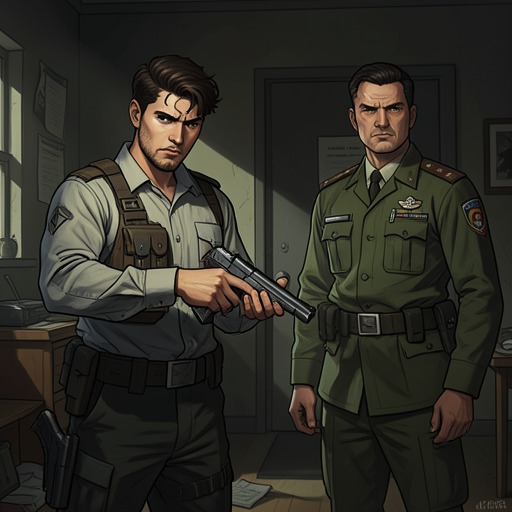
Later, the gun served as a direct means of intimidation against Sport. Travis pressed Sport back against a wall with the short barrel of the .38 Special, turning the compact weapon’s practical form into leverage at close quarters. Across these episodes, the gun moves from an object Travis handles in anticipation of danger to a weapon fired in a chaotic street-level encounter and then brandished against a person. Its presence marks the growing overlap between his pursuit of a heroic identity and his capacity to threaten and harm others.
Place in Travis’s Arsenal
After leaving Iris, Travis went directly to a shooting range with the Magnum in a bag in his car, the .38, and another small pistol. He fired for a long time—about a hundred shots—but the account does not identify which weapon he used for each shot. The .38 was therefore part of a practiced, multiple-gun arsenal, not merely a concealed accessory for his taxi shifts. Its role in that arsenal is clear even where the specific weapon used in later planned violence is not: the narrative does not establish that Travis used the .38 in his attempted attack on Charles Palantine, or that it caused the deaths later reported in the newspapers.